
Virtual Card Platform
Designing a scalable lifecycle management platform for virtual cards
Senior Director of Design | Capital One | 2025-2026
The Problem
As enterprise customers increasingly relied on digital purchasing, virtual cards became a critical tool for secure transactions and spend control. However, the existing ecosystem was fragmented.
Virtual card workflows were spread across multiple systems, with inconsistent experiences for requesting, issuing, managing, and reconciling cards.
Key challenges included:
Fragmented lifecycle workflows across request, approval, issuance, and reconciliation
Legacy processes tied to physical card infrastructure
Limited visibility and control for business administrators
Slow operational processes for finance and procurement teams
This fragmentation created operational inefficiencies and limited the scalability of virtual card programs across enterprise customers.
My Role
I led the design vision for the virtual cards platform across Capital One’s Card and Bank organizations.
My focus was establishing a scalable experience framework that could support enterprise use cases while aligning multiple product and engineering teams around a shared platform direction.
Key responsibilities included:
Facilitating visioning workshops with executive stakeholders
Leading cross-functional discovery across product, engineering, and operations
Defining the platform capability map and experience architecture
Guiding the design team through concept development and strategic prototyping
Aligning design strategy with enterprise payments platform initiatives
Key Decisions
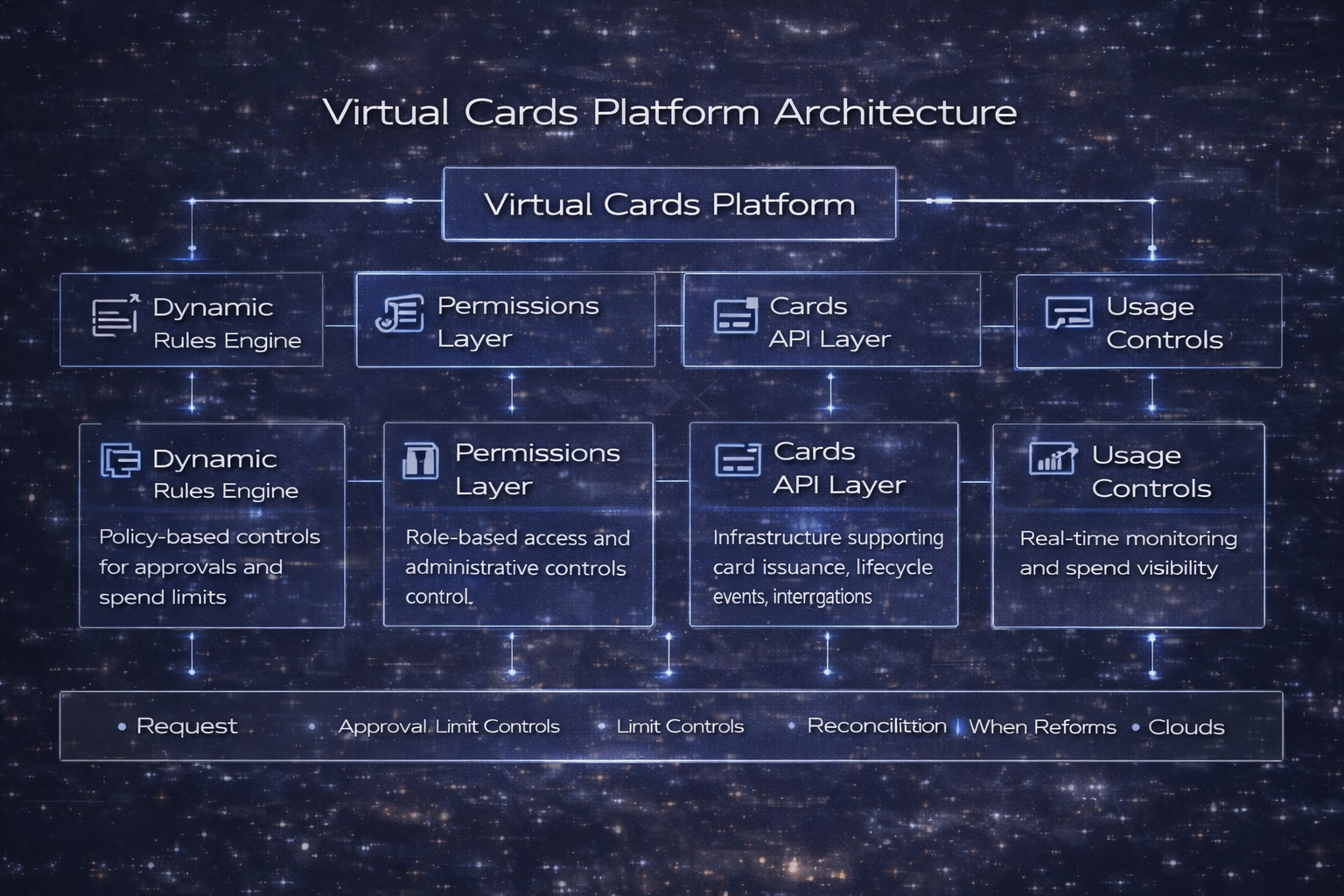
Dynamic Rules Engine
Approval workflows and spending controls were structured through a flexible rules engine that allowed organizations to define policies based on roles, budgets, and purchasing categories.
This provided administrators with fine-grained control over card issuance and spend management.
Fine-Grained Permissions
We introduced a permission framework that enabled organizations to manage access and responsibilities across multiple roles including finance teams, administrators, and employees.
This allowed companies to delegate purchasing authority while maintaining strong oversight.
Real-Time Controls
Usage monitoring and spend visibility were surfaced in real time, enabling organizations to track card activity and enforce policies dynamically.
This improved transparency and reduced risk for enterprise customers.
Execution
Execution required coordination across multiple teams and product domains.
The work included:
Facilitating cross-team design alignment across the payments ecosystem
Leading rapid concept prototyping to explore lifecycle workflows
Conducting stakeholder workshops to align platform direction
Collaborating with engineering teams to define scalable platform architecture
Integrating platform capabilities with existing design system standards
This process ensured the solution aligned both with customer needs and with broader enterprise platform initiatives.
The System Architecture Behind the Work
Most portfolios focus on interface solutions. However, for platform initiatives, defining the system architecture is essential before designing the experience layer. The virtual cards platform architecture was structured around core capability layers:
Leadership Impact
The initiative helped establish a structured foundation for enterprise virtual card programs.
Key outcomes included:
Alignment across multiple product teams around a shared virtual card platform vision
Improved lifecycle clarity for enterprise customers managing purchasing workflows
A scalable architecture capable of supporting future virtual card expansion
Stronger operational frameworks for administrators managing enterprise spend
Leadership Reflection
Large-scale platform initiatives require aligning multiple teams around a shared system architecture before focusing on interface solutions.
This initiative reinforced the importance of establishing clear platform capabilities early in the process to ensure teams could build consistently and scale efficiently.
Future opportunities for the platform include:
deeper integrations with enterprise finance and procurement systems
expanded real-time controls for administrators
AI-driven insights for spend management and fraud prevention
These capabilities will further strengthen the role of virtual cards as a foundational component of enterprise payments infrastructure.