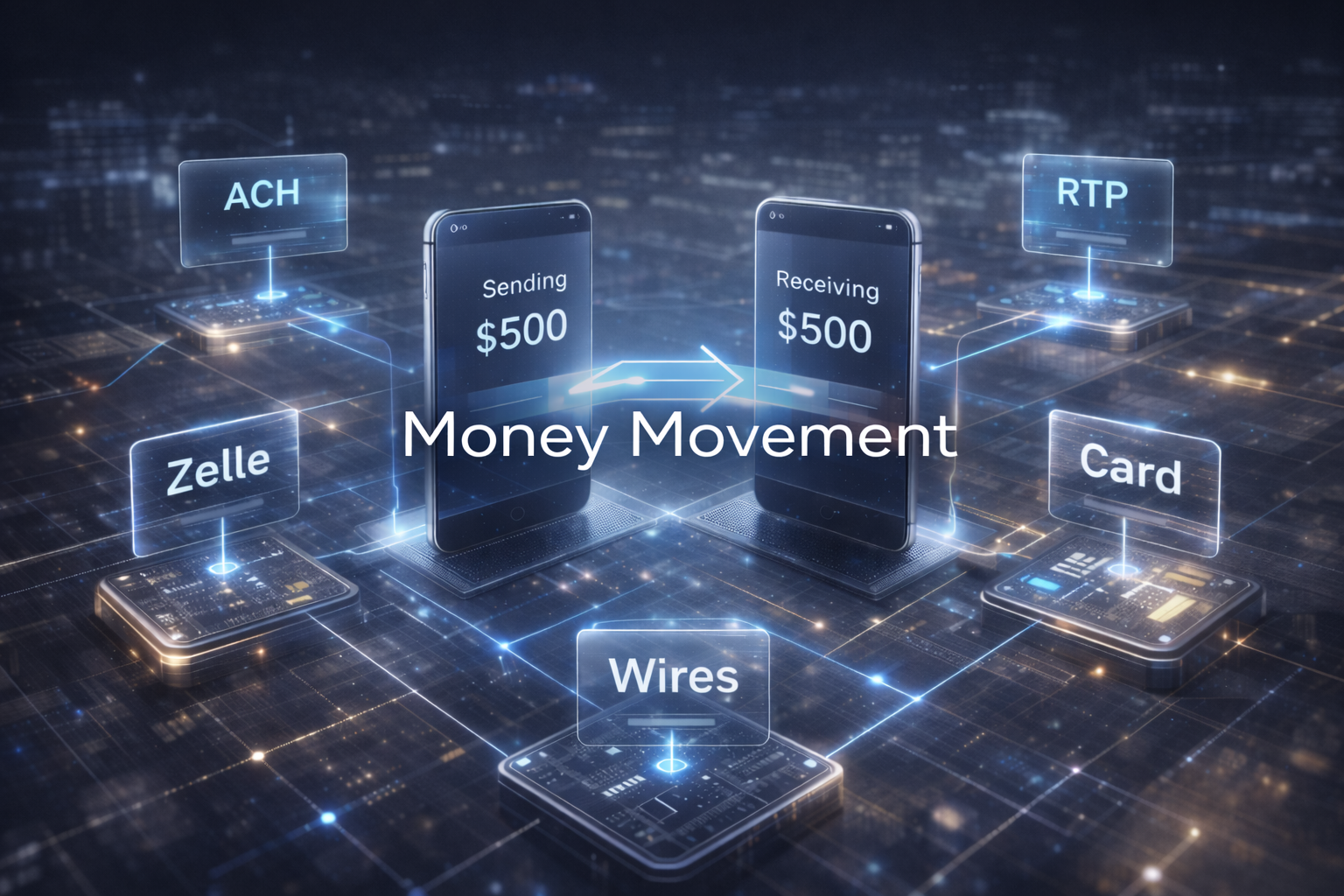
Money Movement Orchestration
Designing an intelligent experience layer that routes payments across multiple financial rails.
Senior Director of Design | Capital One | 2026
The Problem
Customers move money across a variety of financial rails, including ACH, RTP, Zelle, Wires, and Cards.
However, each rail operates with its own rules, limitations, and user flows.
This created fragmented experiences where customers had to understand:
which payment rail to choose
eligibility requirements for each rail
transaction limits and settlement speeds
different interaction patterns across products
For many customers, the complexity of these systems surfaced directly in the experience. Instead of moving money intuitively, customers were forced to make technical decisions about financial infrastructure.
My Role
I led the design strategy for rethinking how customers interact with money movement across Capital One’s payments ecosystem.
The goal was to create a unified experience layer capable of intelligently routing transactions across rails while maintaining transparency and trust for customers.
Key responsibilities included:
defining the product vision for cross-rail orchestration
aligning stakeholders across multiple payment platforms
facilitating strategic design workshops to explore platform direction
guiding the design team through concept development and prototyping
partnering with engineering to define platform architecture
The Strategy
Rather than designing experiences around individual payment rails, we reframed the problem around customer intent.
Customers don’t think in terms of ACH or RTP. They simply want to move money quickly, safely, and reliably.
Our strategy focused on designing an intelligent orchestration layer that could:
understand the context of a transaction
determine the most appropriate rail
surface recommendations when helpful
simplify the experience without hiding important details
This allowed the system to absorb infrastructure complexity while keeping the experience intuitive.
Key Decisions
Progressive Disclosure
Payment rail complexity was only surfaced when necessary.
Most transactions could be completed through a simple flow, while advanced options remained available for customers who needed more control.
Capability-Based Architecture
Rather than organizing experiences around payment types, we structured the platform around core capabilities:
sending money
requesting money
depositing funds
transferring between accounts
This allowed the experience to remain consistent regardless of which rail executed the transaction.
Context-Aware Recommendations
The system leveraged transaction context to recommend the most appropriate payment rail based on factors like speed, cost, and eligibility.
This improved customer confidence while reducing decision friction.
Execution
Execution required coordination across multiple product and engineering teams responsible for different payment rails.
Key activities included:
facilitating cross-team alignment workshops
mapping capability architecture across payment platforms
developing rapid prototypes to explore orchestration concepts
collaborating with engineering to define platform integration points
aligning the experience with broader design system standards
Leadership Impact
This work helped establish a long-term vision for how money movement could evolve into a unified platform experience.
Key outcomes included:
alignment across payment teams around a shared orchestration strategy
reduced complexity in cross-rail payment experiences
a scalable architecture for expanding future payment capabilities
a clearer experience model for customers interacting with multiple rails
The System Architecture Behind the Work
The orchestration layer sits above the individual payment rails and determines how transactions are executed.
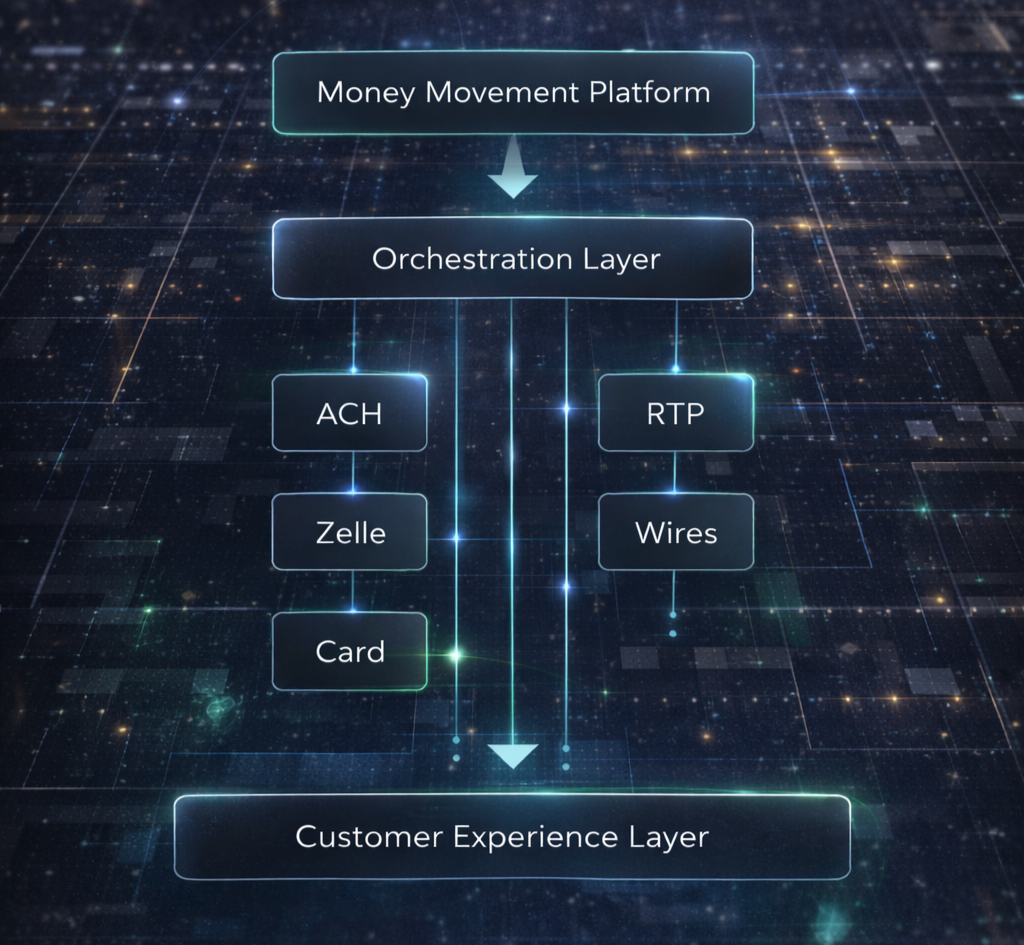
This structure allows the platform to scale while keeping the customer experience simple.
Leadership Reflection
Complex financial ecosystems require experience design that starts with platform architecture.
By aligning teams around a shared orchestration model, we were able to simplify the customer experience while maintaining the flexibility needed for a large-scale payments ecosystem.